
He was shot at while driving for Lyft. He cooperated with police. A federal judge just denied his release from ICE custody.
Inside the ruling that shut down a detained crime victim's bid for release.
Yunior Sosa Ordonez is a Cuban national who entered the United States in October 2021 and was released on his own recognizance pending removal proceedings. He settled in Louisville, Kentucky. He applied for asylum, a green card, and a U-visa — the visa Congress created specifically for victims of serious crimes who cooperate with law enforcement.
He worked as a Lyft driver in Jefferson County.
One day, a passenger pulled a handgun, forced him to stop the car, shot at him, and stole his vehicle. The suspect was apprehended, charged with multiple felonies, and is awaiting trial in Jefferson County Circuit Court. Sosa Ordonez is the sole victim and the sole witness. Louisville Metro Police certified his I-918 Supplement B — the federal form confirming that he is a victim of a qualifying violent crime, that he cooperated with the investigation, and that his continued cooperation is expected.
In June 2025, he was cited for expired plates and failure to maintain insurance. He pled guilty to the insurance charge and paid a fine. In October 2025, he failed to appear in court on the violation. He was arrested, and ICE took custody the same day.
He has been detained at Oldham County Detention Center since then. His removal hearing is scheduled for April 7, 2026.
Today, a federal judge denied every claim he raised in his bid for release.
What he asked for and what happened
After ICE detained him, Sosa Ordonez’s attorney emailed ICE’s Chicago outreach inbox requesting his parole or release. The email cited his status as the victim and sole witness in a pending violent felony prosecution, his cooperation with law enforcement, and his lack of criminal history beyond the traffic citations.
An ICE agent named Jason Johnson responded. He said he could not release anyone on parole and directed counsel to seek relief before an immigration judge.
Counsel did. On January 14, 2026, Immigration Judge Kelly Johnson held a bond redetermination hearing and denied Sosa Ordonez’s request for release. The IJ’s ruling rested on two alternative grounds. First, under Matter of Yajure Hurtado, 29 I&N Dec. 216 (2025), the IJ found he lacked authority to grant bond if Sosa Ordonez was detained under 8 U.S.C. § 1225. Second, if Sosa Ordonez was instead detained under § 1226 — the statute that does provide for bond hearings — the IJ found him to be a danger to the community and a flight risk.
The danger and flight risk findings were applied to a man whose entire criminal record is a traffic citation.
After that denial, Sosa Ordonez filed a habeas corpus petition and an emergency motion for a temporary restraining order in the Western District of Kentucky, asking U.S. District Judge Claria Horn Boom to order his immediate release from ICE custody. He raised four arguments: that his continued detention violates due process, that ICE’s refusal to grant parole was arbitrary and unconstitutional, that his detention interferes with Kentucky’s sovereign authority to prosecute crime, and that his pending U-visa status should prevent his removal.
Judge Boom denied the petition, denied the TRO, and dismissed the case with prejudice. She signed the judgment today, April 6, 2026.
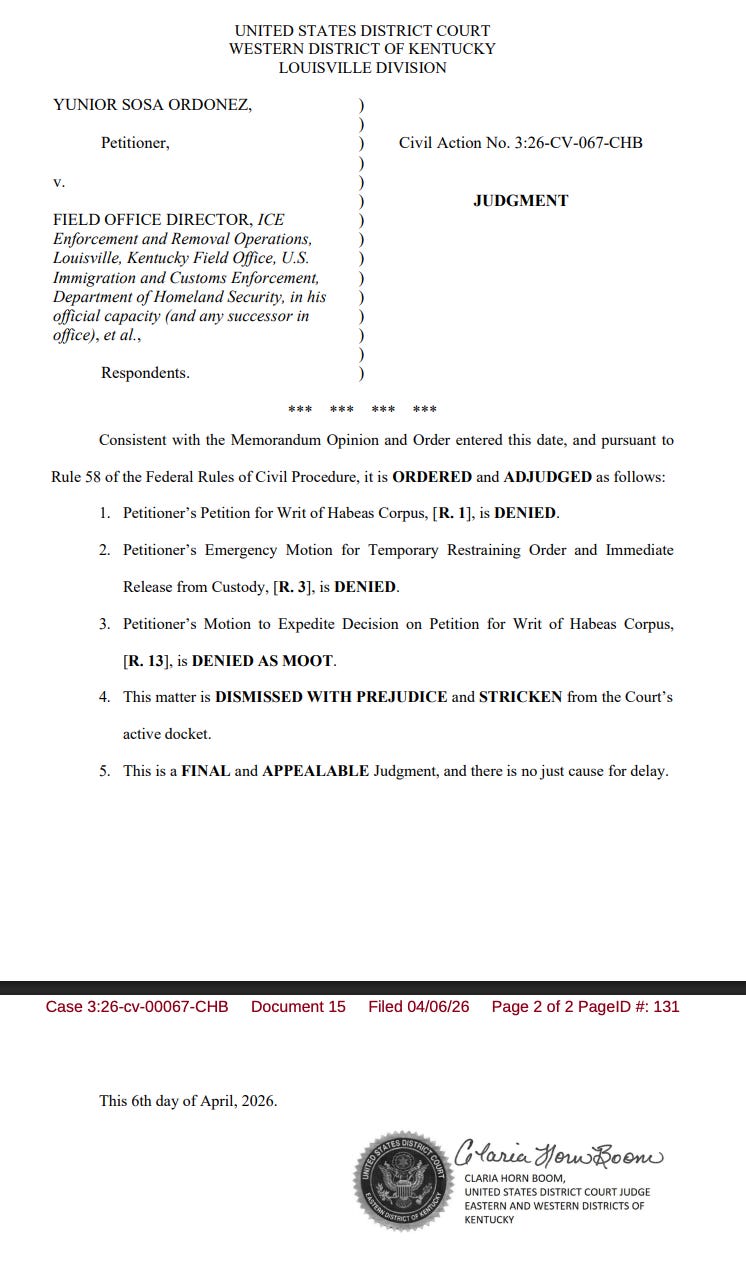
How the court closed each door
The bond hearing
The central question was whether Sosa Ordonez received adequate process to justify his ongoing detention.
Boom found that he did. The IJ’s dual ruling — one finding under § 1225, one under § 1226 — covered both possible statutory frameworks for his detention. If he was detained under § 1225, the IJ correctly applied Matter of Hurtado and found no authority to grant bond. If he was detained under § 1226, the IJ held a hearing and made findings on dangerousness and flight risk. Either way, the process owed to him under the statute was delivered.
Boom acknowledged the IJ could have explained this reasoning more clearly. But she read the ruling as doing what it needed to do: addressing both statutory possibilities and reaching a conclusion under each one.
Sosa Ordonez argued his detention “no longer serves any legitimate civil or regulatory purpose,” citing Zadvydas v. Davis for the principle that indefinite detention without justification violates due process. Boom rejected this. Zadvydas addressed confinement lasting years — and concerned noncitizens who had already received final orders of removal. Sosa Ordonez has been detained roughly six months and has no final removal order. The constitutional clock the Zadvydas framework contemplates, Boom wrote, has not started.
She also made clear that to the extent Sosa Ordonez was challenging the IJ’s discretionary decision to deny bond — as opposed to the statutory framework itself — 8 U.S.C. § 1226(e) strips the federal court of jurisdiction to review that decision. Congress gave immigration judges the authority to make bond determinations. The IJ made one. Federal courts cannot second-guess it.
The parole denial
Sosa Ordonez argued that ICE’s refusal to release him on parole was arbitrary and unconstitutional. Parole authority under 8 U.S.C. § 1182(d)(5)(A) allows the Secretary of Homeland Security to parole noncitizens into the country on a case-by-case basis for urgent humanitarian reasons or significant public benefit. That authority is, in the Supreme Court’s language, “exceedingly broad” and discretionary.
Boom found two problems with this claim. First, it was undeveloped. Sosa Ordonez cited no law limiting ICE’s discretion, didn’t engage with the government’s argument that parole decisions aren’t judicially reviewable, and didn’t even cite the relevant statutes — § 1182 or § 1252 — in his reply brief. The court treated the argument as waived.
Second, Boom noted the nature of the parole request itself. Counsel sent an email to ICE’s general Chicago outreach inbox. The agent who responded — Jason Johnson, whose title and authority within ICE were unclear from the record — said he could not release anyone on parole. Sosa Ordonez’s petition framed this as ICE “disclaiming authority” to grant parole, suggesting a jurisdictional vacuum where no one would take responsibility for his confinement.
Boom rejected that framing. She pointed out that Sosa Ordonez’s own filings described the situation inconsistently — sometimes as ICE disclaiming parole authority altogether, sometimes as ICE simply refusing to grant parole in his case. A single email from an agent of unknown standing, Boom wrote, cannot represent an official agency position abandoning its statutory parole power. And notably, Sosa Ordonez’s briefing did not suggest he ever filed a formal parole request under ICE’s § 1182 authority, as distinct from the email.
Kentucky’s sovereign interest
This was the most factually compelling argument Sosa Ordonez raised. He is the sole victim and sole witness to a violent armed carjacking being prosecuted in Jefferson County Circuit Court. The Jefferson County Attorney’s Office requested his continued presence and availability to testify. His lawyers argued that federal detention of the only witness to a pending state felony prosecution interferes with Kentucky’s sovereign authority to enforce its criminal laws.
Boom disposed of it on standing grounds first. Under Linda R.S. v. Richard D., 410 U.S. 614 (1973), a private citizen has no judicially cognizable interest in the prosecution or nonprosecution of another person — even as the victim of the crime.
Then she addressed the merits anyway. Citing the Eleventh Circuit’s decision in San Pedro v. United States, she noted that even federal prosecutors cannot halt deportation proceedings. Permitting state prosecutors to do so would go further still, and no delegation of that authority exists.
The practical result: a state prosecution depends on Sosa Ordonez’s testimony, the county attorney asked that he remain available, and the federal court found that neither the witness nor the state has a legal mechanism to prevent his removal from the country.
The U-visa
Sosa Ordonez’s final argument was that his certified crime-victim status under the U-visa program should support his release, because his detention defeats the purpose of the statute.
The regulation answers this directly. 8 C.F.R. § 214.14(c)(1)(ii) provides that a pending U-visa petition “has no effect on ICE’s authority to execute a final order” of removal. A petitioner subject to a final order may seek a stay of removal through the immigration process while the U-visa application is pending. The federal court will not intervene on this basis.
What this means
This opinion does not order Sosa Ordonez’s removal. It does not address the merits of his removal case, which is scheduled for hearing tomorrow before IJ Johnson. It does not find his U-visa application meritless.
What it does is close the federal courthouse door to his detention challenge — with prejudice. The judgment is final and appealable to the Sixth Circuit.
Judge Boom is building a body of law in this space. This is the same judge who issued Martinez-Elvir v. Olson in October 2025, which she cites here extensively and which laid out the § 1225/§ 1226 framework she applied again today. That earlier opinion established that noncitizens detained under § 1225 are not entitled to bond hearings before immigration judges — and that those detained under § 1226 receive them, but the federal court cannot review the IJ’s discretionary decision on the merits.
Today’s ruling extends that framework. It addresses what happens when a detained noncitizen tries every other available argument — parole, state sovereignty, pending visa status — and finds that none of them create a right to release that a federal court can enforce.
For detained noncitizens in the Sixth Circuit, the practical landscape after this ruling is narrow. If you received a bond hearing and lost, the federal court will not revisit the IJ’s determination. If ICE denied parole, that decision is discretionary and unreviewable. If a state prosecution needs your testimony, you lack standing to assert the state’s interest. If you have a pending U-visa, it does not affect ICE’s custody or removal authority.
The appeal path to the Sixth Circuit remains open. Whether that court sees this framework the same way Boom does is the next question — and it fits within the broader circuit split over bond hearing rights that continues to develop across the country.
The case is Sosa Ordonez v. Field Office Director, ICE, No. 3:26-CV-067-CHB (W.D. Ky.), decided April 6, 2026. Judge Claria Horn Boom presiding.
Does the discretion given the IJ judge on a parole bond hearing--and the inability of the courts to deal with that --apply if the reason for refusing is arbitrary and capricious? Did the IJ indicate WHY he was a flight risk? Or a danger?
Did he appeal this IJ judgment to the BIA? If one is pending, can't a Federal judge enjoin deportation till that appeal is done? That would not be itself challenging the discretion of the IJ, it would just be ensuring his right of due process to get his appeal finished. It doesn't weigh in on the right or wrong of parole; he'd have to stay in custody till BIA makes the final decision.
Meanwhile couldn't he be released in the custody of the KY cops when it comes time to testify? If THEY petition the immigration court for permission.