
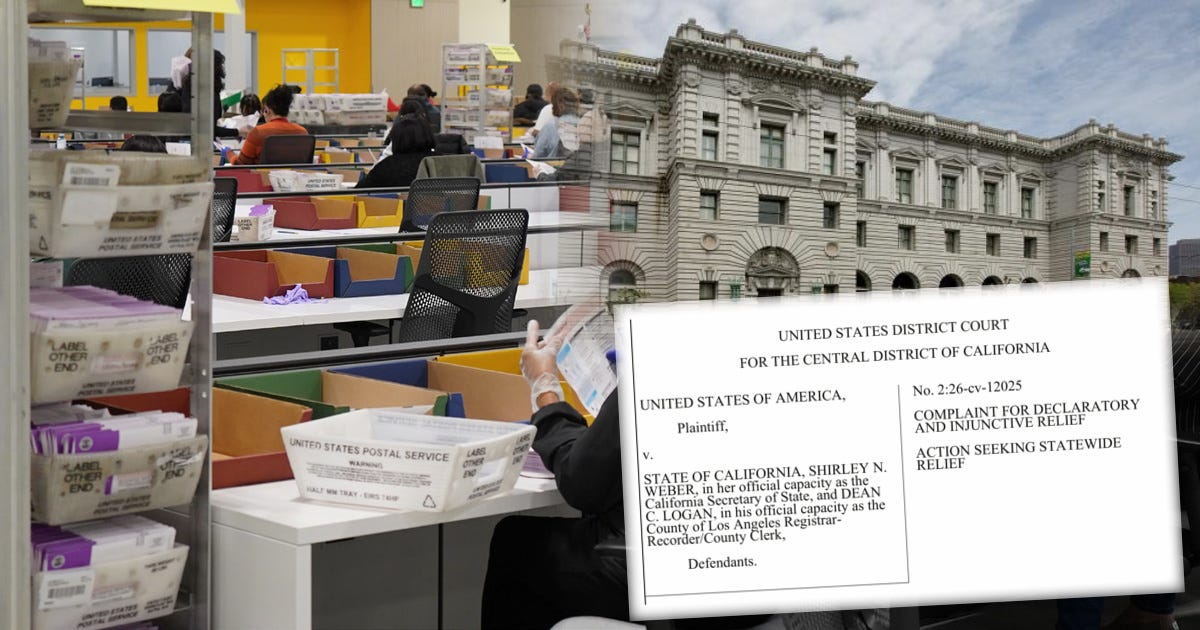
A Sunday argument, no ruling yet
On Sunday, Oct. 25, a Ninth Circuit panel heard emergency argument on a Justice Department request to stop California from counting mail ballots from about 20,000 voters the federal government says are likely noncitizens. The panel took the case under submission. Judge Mark Bennett said the court will “try to decide this case as quickly as possible, commensurate with the issues and interests involved.”
DOJ came to the appeals court before the trial judge had ruled. U.S. District Judge David O. Carter set a hearing on DOJ’s request for Tuesday, Oct. 27. DOJ asked him to rule by noon on Oct. 22, and when he didn’t, it appealed and argued that the missed deadline amounted to a denial.
The panel was Bennett and Patrick Bumatay, both Trump appointees, and Gabriel Sanchez, a Biden appointee. Bennett and Sanchez spent most of DOJ’s time on jurisdiction and on the reliability of its list. Bennett also questioned whether a 1996 criminal statute lets a federal court change how a state counts ballots. Bumatay pressed California on how it verifies citizenship at all. Matthew Donnelly argued for DOJ, Samuel P. Siegel for California and Secretary Weber, and Seth P. Waxman for LA County Registrar Dean Logan.
This piece walks through the record: what each side filed, what was said in court, and what has been decided. As of Sunday evening, nothing has.
Where the list came from
The federal government first raised its numbers in July. On July 16, Homeland Security Secretary Markwayne Mullin wrote to California Secretary of State Shirley Weber that a “preliminary review” of the state’s voter data showed “there may be as many as 190,832 non-citizens registered to vote in California.” The letter said DHS had found “81,336 California registrants for whom the name, date of birth, address and Social Security number match a non-citizen in our files.”
Weber answered a week later. She wrote that she had “serious doubts about the reliability of your data,” because her office “has not shared our statewide voter registration list with DHS or any other federal agency or official.” She asked for the methodology, “including, but not limited to, all data sources, software, and matching criteria,” whether AI was used, and how DHS came to possess the list. LA County’s filing says DHS “did not provide the requested methodology or otherwise respond.”
This was DOJ’s second election fight with California in front of Judge Carter. In January, he dismissed DOJ’s lawsuit seeking the state’s unredacted voter file, calling the request “unprecedented and illegal,” NPR reported. Weber’s July letter cites that ruling, United States v. Weber.
DHS’s own declarations describe the list’s origin in one sentence. Eric McLoughlin of Homeland Security Investigations wrote: “Our office received what appeared to be the California voter roster for the general election of 2026. The roster appeared credible enough for our office to initiate our investigative processes.” He does not say who supplied it. He says the file reflects California’s rolls “as of August 2025.” A USCIS official, Nic Bartell, says his unit received the rolls from HSI “on or around May 8, 2026.”
At argument, DOJ’s lawyer said the United States “did not purchase the list, but the United States was supplied a list that was purchased originally from California.” Asked who the third parties in the process were, he said: “I don’t want to mislead the court, so I I don’t have that information in front of me.”
The lawsuit
On Oct. 13, Acting Deputy Attorney General R. Trent McCotter sent letters to Weber and to LA County Registrar Dean Logan. An HSI agent hand-delivered a password-protected drive with the list to Logan’s office. The letters asked officials to “review the list within 48 hours,” to “segregate—not cancel—” ballots from anyone whose citizenship they could not confirm, and to respond “by October 15 at noon EST.” Otherwise, the letters said, “the United States will have no choice but to seek emergency relief.”
DOJ sued on Oct. 15. The complaint names the State of California, Weber and Logan, and raises a single claim: that California’s actions are preempted by 18 U.S.C. § 611, the federal law making it a misdemeanor for a noncitizen to vote in a federal election. DOJ argues that sending ballots to everyone on the rolls and counting them after a signature check, once officials have the list, “frustrate[s] the very purpose and effect of the federal prohibition against noncitizens voting.”
The relief DOJ wants is an order requiring California “(1) to set aside vote-by-mail ballots from persons identified by the Federal Government likely to be noncitizens and (2) to independently—or in collaboration with the Federal Government—verify their citizenship status (beyond relying on unverified statements of citizenship necessary to registering).”
The declarations describe how the list was built in general terms. USCIS combined the voter file with “a reliable third-party data analytics and investigative platform” and “third party commercial data,” scored matches against its own records, and ran manual reviews. HSI then did further “enrichment” using “approved analytic capabilities,” which “resulted in over 20,000 individuals remaining on the list.” Neither declaration names the third-party platform. Both include a footnote: “approximately 189 records with minor data discrepancies” appear on the list sent Oct. 13. Bartell adds that USCIS has flagged “a separate batch of more than 17,000 voting records.”
On Oct. 19, DOJ announced charges against 28 people in California. NPR reported that all 28 were green card holders and all appeared on the 20,000-name list, and that some had registered more than 20 years ago.
Nov. 3, then noon the next day
DOJ’s first two requests for a temporary restraining order set Election Day as the deadline. Its Oct. 19 memorandum asked Carter to “grant this relief by November 3, 2026, before the end of voting in the 2026 federal election.” The case moved to Carter on Oct. 21 as related to the January voter-roll suit. DOJ refiled that day with the same request, “by November 3, 2026.” Carter set the hearing for Oct. 27.
That evening DOJ changed the deadline. Citing LA County’s filing that it had “processed more than 331,000 VBM ballots,” DOJ asked for a ruling “by noon on October 22, 2026.” It filed a notice of appeal on Oct. 22.
Carter’s Oct. 23 order lays out the sequence: the Nov. 3 requests, the transfer, the hearing set “one week before the United States’ requested date of relief,” and the request filed “later the same evening” for a ruling by noon. He wrote that the court “will rule promptly after hearing from the Parties at oral argument on Tuesday, October 27, 2026.”
Oct. 15: Complaint filed.
Oct. 19: First TRO application asks for relief “by November 3.”
Oct. 20: LA County reports more than 331,000 ballots processed.
Oct. 21: Case transferred to Carter. DOJ refiles, again “by November 3.” Carter sets the hearing for Oct. 27. That evening DOJ asks for a ruling by noon Oct. 22.
Oct. 22: DOJ files a notice of appeal.
Oct. 23: Carter’s order restates the timeline. DOJ files its emergency motion in the Ninth Circuit.
Oct. 24: California and LA County respond. The panel sets Sunday argument.
Oct. 25: Argument. The case is submitted.
Meanwhile, the state says, federal agents delivered a thumb drive to the Secretary of State’s office on Oct. 23, and federal agencies sent letters to counties across California the same day. The letters gave officials 48 hours and warned that they “risk becoming aiders and abettors to a federal crime.”
DOJ’s Sunday morning briefs in the Ninth Circuit give its account of the shift. When it first asked for relief by Nov. 3, the brief says, it “was unaware that California’s processing rendered ballots untraceable once removed from their envelopes.” It says LA County’s count rose from 331,000 processed ballots on Oct. 20 to 550,000 four days later. It asks the panel to “order the district court to cancel Tuesday’s hearing because the district court lacks jurisdiction.” On LA County’s sample, DOJ’s reply says: “even assuming that California is right, that means it is still tabulating thousands—if not over 10,000—unlawful votes.”
LA County’s reply, filed an hour before argument, calls the emergency “entirely ‘self-inflicted.’” It says DOJ filed suit “minutes after its unilaterally imposed deadline passed, without mentioning that L.A. County had responded,” and asked Carter for a noon ruling “barely two hours” after he set the hearing. It notes that the county livestreams its mail-ballot processing and that its website says the ballot “will … be separated from the return envelope, and then it will be tallied.”
Jurisdiction: was there anything to appeal?
Appeals courts generally review orders, and Carter had not issued one. DOJ’s theory is that his failure to rule by its deadline was a “constructive denial” of an injunction, which can be appealed. It relies on A.A.R.P. v. Trump, the 2025 Alien Enemies Act case. DOJ’s Sunday brief quotes the Supreme Court: “A district court’s inaction in the face of extreme urgency and a high risk of ‘serious, perhaps irreparable,’ consequences may have the effect of refusing an injunction.”
Bennett opened there. He walked through the Nov. 3 requests and the noon demand, then said: “This seems to me far, far, far different than AARP, where people were about to be deported.” Asked about the Oct. 21 filing that still named Nov. 3, DOJ’s lawyer said, “I don’t want to say it’s an accident, but I would say that you know perhaps it was you know an oversight.”
Sanchez pointed to California Elections Code § 15101, which lets officials begin processing mail ballots when they go out, no later than 29 days before the election. He asked how DOJ could describe California’s mail system in detail in its complaint without knowing that. DOJ’s lawyer said, “I don’t believe we were saying that we didn’t know that they could process them right away.” What changed, he said, was the scale. When Bumatay offered a framing, that facts had changed once DOJ saw how many ballots arrived early, DOJ’s lawyer agreed: “Yes, that’s exactly correct, Your Honor... we did not appreciate the scale.”
Bennett then turned to the filing date. “You were the master of the filing of your complaint,” he said, and DOJ could have filed a month earlier. DOJ’s lawyer: “we did not have our list that we gave to the defendants processed at that point.” In rebuttal he added that DOJ wanted “a complaint that was able to incorporate the finalized list.”
On the other side, Seth Waxman, arguing for LA County, said DOJ “gave this hardworking, very diligent district judge three hours, and when three hours passed, they appealed, and that is not constructive denial of an unappealable order.” Sanchez pushed him on the comparison, noting that A.A.R.P. also turned on a matter of hours. Waxman answered that in A.A.R.P. the courts risked losing jurisdiction as people were removed: “here nobody’s leaving the jurisdiction.”
Bennett asked all three lawyers whether Carter can still hold Tuesday’s hearing while the appeal is pending. They gave three answers.
California (Sam Siegel): “Our position is that it does.”
LA County (Waxman): “The short answer is we are not sure.”
DOJ: “That jurisdiction has been divested from the court as far as the injunctive relief requested here.” He agreed that a dismissal for lack of jurisdiction would send the case straight back.
Bumatay asked DOJ whether it would be prejudiced if the panel ruled Monday night or Tuesday morning. Sanchez asked whether an order from Carter after Tuesday’s hearing could bring the case back up. DOJ’s lawyer said yes, adding that “either side is probably going to appeal it, no matter what it is.”
The merits: what § 611 can do
The Constitution’s Elections Clause says the “Times, Places and Manner” of congressional elections “shall be prescribed in each State by the Legislature thereof,” and that “Congress may at any time by Law make or alter such Regulations.” Bennett built his questions on that text and on Smiley v. Holm (1932), in which Chief Justice Charles Evans Hughes described state power over elections as reaching matters such as “notices, registration, supervision of voting, protection of voters, prevention of fraud and corrupt practices.”
California bans noncitizen voting, as federal law does, and requires a sworn citizenship statement. Bennett asked: “Why doesn’t the elections clause foreclose the relief you are requesting here, especially given what the chief justice said for the court in Smiley?” DOJ’s lawyer began, “I want to start off by apologizing that I’m not incredibly familiar with Smiley,” and turned to § 611.
Bennett’s view of § 611 was that a criminal ban is not Congress altering California’s election rules. “How can we, a federal court, do what is reserved to Congress, which Congress, in my view, hasn’t done?” DOJ’s answer was that “California isn’t interested in enforcing that provision; they are simply relying on attestations.” Bennett, noting the state’s own process for challenging ballots: “You just don’t think it’s good enough.”
He then read California Elections Code § 15106, which puts on a challenger to a mail ballot “the burden of establishing extraordinary proof of the validity of the challenge.” DOJ’s declarations call their information “reliable,” “highly reliable” and “credible.” DOJ’s lawyer said that if California law requires more, “then it would be preempted.”
Sanchez raised the Tenth Amendment, which bars the federal government from commandeering state officials. DOJ called segregation “basically a ministerial task. We are not asking for votes not to be counted.” Bumatay offered DOJ a way around the problem: if § 611 is an Elections Clause law, Arizona v. Inter Tribal Council (2013) takes anti-commandeering off the table. “I certainly agree with your second point,” DOJ’s lawyer said.
California’s lawyer, Sam Siegel, argued that § 611 “criminalizes; it doesn’t preempt California’s laws.” Asked whether § 611 was enacted under the Elections Clause, he said, “No, Your Honor. We would vigorously dispute that assertion.” Asked for a source: “I don’t know, and I’m sorry.” Congress added § 611 in 1996 as part of the Illegal Immigration Reform and Immigrant Responsibility Act.
Bumatay pressed Siegel from DOJ’s side. “Having non-qualified people like non-citizens vote is is a manner restriction, don’t you think?” Both governments agree on who may vote, he said, so the dispute is about the manner of voting. Siegel answered that the Supreme Court in Inter Tribal Council separated time, place and manner from rules about who may vote.
Bennett asked Siegel to agree that Congress could, in theory, require states to segregate ballots when citizenship is questioned, but had not done so. “That is absolutely correct, Your Honor.” Sanchez asked whether reading § 611 to require verification would conflict with the NVRA and HAVA, the federal voting laws built on a sworn citizenship statement. “I think it would, Your Honor.”
Bennett then stated his problem with the case: “Congress and the California legislature have said non-citizens can’t vote, and this lawsuit is about we don’t like the way you’re sorting citizens from non-citizens, and I just don’t see 611 as telling California how to do the sorting.”
Bumatay kept going. He asked how California verifies citizenship when a voter is challenged. Siegel: “I honestly don’t know the answer to that question.” Bumatay: “So it’s not that extraordinary to ask California to verify citizenship of a voter.” He put the same question to Waxman, and when Waxman described a process that runs only through challenges, asked: “how is that not a violation of 611 in itself?” Waxman said § 611 “looks to the voter” and “has nothing whatsoever to do with time, place, and manner.”
In rebuttal, Sanchez asked DOJ for its cause of action, since the Supremacy Clause does not supply one on its own. DOJ’s lawyer said the government relies on the court’s “general equity powers.” Sanchez asked, citing Trump v. CASA, whether there is a historical tradition of federal courts intervening in a state’s elections where Congress has not spoken. “Your Honor, I apologize. I do not have that off the top of my head.”
🤍
Support independent court coverage.
The list on trial
Sanchez spent much of his time on the list itself. The declarations cite “third-party data” and “reliable third-party analytics.” He asked which third parties. DOJ’s lawyer did not have that information, and later said, “while I might not know who the third party you know software that was used as part of the rigorous process, we have two DHS employees who have sworn declarations that is reliable.”
Sanchez noted that the July letter claimed about 190,000 possible noncitizens, and the list now has 20,000. DOJ’s lawyer said the July list “had not gone through” what he called “the rigorous process” in the declarations. Sanchez then tied the questions back to timing: “somehow the district court was supposed to resolve all this in a matter of hours by noon on October 22, when we don’t even know who the third parties are.”
Asked what gives DOJ confidence in the list, its lawyer pointed to LA County’s review of a sample of about 200 names: “the confidence was shored up by defendant’s reaction to the list.” LA County had filed that review on Oct. 20, in a declaration from Aman Bhullar, who runs the registrar’s information technology bureau:
42.9% of the sampled records were canceled registrations; 42.4% were active and 4.6% inactive.
86 of the sampled individuals had been mailed ballots for this election.
71.2% had never voted in past elections.
“Among the records for which birthplace information was meaningfully reported, 38.9% indicated that they were born in the United States.”
Of the more than 20,000 names, 7,035 have LA County addresses.
Bennett treated the DHS declarations as expert opinion and measured them against Daubert and Kumho Tire, the Supreme Court’s standards for expert evidence. “I don’t see anything in there which would come close to establishing the type of reliability that the Supreme Court has told us, at least in a trial sense, that we need.” The declarations, he said, use “different words which they never explain,” and support at most that people on the list “may be non-citizens.” DOJ’s lawyer answered that the case is moving fast and the government is “simply asking for them to segregate the ballots.”
Bennett also raised Bhullar’s warning of “potential catastrophic impact” from setting the ballots aside. Bhullar wrote that it would require new code in the county’s voter database, a new sort program for its ballot sorters and updates to more than 5,000 electronic pollbooks, during an election-system change freeze in effect since Oct. 2. DOJ’s lawyer said California already has segregation processes, and “if they would just work with us, I guarantee it would be much easier than they’re making it out.” Bennett: “their IT guy says they don’t have this process.”
DOJ suggested California could check citizenship through SAVE, DHS’s verification system. Sanchez noted that a mail-ballot envelope carries a name, address and signature, and no Social Security number. “My name is Gabriel Sanchez. I guarantee you there are many Gabriel Sanchez’s in the county of Los Angeles.” He then asked whether DOJ’s own declarations said SAVE was not used to build the list. “I apologize, Your Honor. I don’t have that right off top my head.” The complaint answers the question in a footnote: “USCIS’ process performed here was done independent of SAVE.” Bartell’s declaration says the process “is distinct from” SAVE, a passage Bennett read aloud later in the argument.
California and LA County added their own attacks. Siegel said of the list: “we don’t know where the list came from, and then it is wildly outdated.” Waxman offered his own math: checking 20,000 names against an expected 2.75 million LA mail ballots at three minutes each would take “140,000 man hours.” He also said Nevada checked a similar federal list of about 15,000 names and found every person was a citizen. LA County’s Sunday brief cites a Sept. 24 New York Times story headlined “From 16,000 to 185 to Zero: Trump’s Claims of Illegal Voting in Nevada Fizzle.” In rebuttal, Donnelly disputed Waxman’s account, saying Nevada “just simply responded back that they relied on their attestation.” DOJ’s brief adds that the Nevada letter used data and methods “distinct from the refined processes used to support this lawsuit.” An August Boston Globe report described Nevada’s review as unfinished at that point.
Purcell, harm and standing
The Purcell principle, named for a 2006 Supreme Court case, warns federal courts against changing election rules close to an election. Bumatay asked DOJ how it gets around the risk of confusing election officials with new procedures. DOJ’s lawyer said it is “an administrative, simple remedy.” Sanchez followed up: California law allows ballots to be set aside for individual challenges, not on a federal list, so the order DOJ wants “would be a change in state law on the eve of an election.” DOJ’s lawyer replied that “the status quo is, according to the United statute and the defendant statute, is that non-citizens shouldn’t be voting in elections,” and offered to “work with them to try and cut that down.”
Bennett asked whether DOJ was really seeking a mandatory injunction, one ordering California to act, which faces a higher bar than an order to stop. DOJ’s lawyer said it saw the request as prohibitory, because “the status quo is that only citizens should be allowed to vote in California’s elections,” and argued it would meet either standard.
Siegel opened California’s argument by saying the district court “has not entered an appealable order” and that DOJ’s request “would sow confusion and risk disenfranchising voters.” On weighing the dueling declarations, he said: “This court is a court of review, not first view.” On Purcell, he cited Justice Kavanaugh’s concurrence in Merrill v. Milligan, which lists four factors, and argued DOJ fails each: the merits must be “entirely clear-cut,” the harm irreparable, the delay not undue, and the change feasible.
Bumatay challenged him on harm: “if non-citizens are voting in California elections, that does seem like a harm.” Siegel said, “we just dispute the factual premise that there are non-citizens voting.”
Waxman argued that nothing about the count stops DOJ from investigating or prosecuting anyone later, because “the registrar is required to keep all materials, including these envelopes, for at least 22 months.” He said a losing candidate who has evidence of ineligible votes can bring an election contest under state law. He told the panel that the segregation provisions DOJ points to cover in-person provisional ballots and recounts, and that “there is no legal or operational way to segregate vote by mail ballots.” On standing, he cited FDA v. Alliance for Hippocratic Medicine for the point that the government “can’t spend its way into standing,” and the Ninth Circuit’s 2024 decision in Election Integrity Project California v. Weber, which he said held that a claim of vote dilution does not provide standing.
In rebuttal, DOJ’s lawyer said the point of § 611 is “to deter the illegal vote before it happens, and so that is the basis of our preemption.” He listed the government’s injuries as its sovereign interest in election integrity, “the interest in having its federal criminal statutes not be flouted,” and violation of the Supremacy Clause. He closed by asking for a ruling “as soon as possible”: another two or three days, he said, means “hundreds of 1000s of votes just in LA County” processed without segregation.
What happens next
The panel can dismiss the appeal for lack of jurisdiction, deny DOJ’s motion, or grant an injunction pending appeal. A dismissal would return the case to Carter, whose hearing on DOJ’s TRO application is set for Tuesday, Oct. 27, at 1 p.m. Motions to dismiss are set for Oct. 30. Election Day is Nov. 3. Whatever happens, Donnelly told the panel, “either side is probably going to appeal.” As of the last docket entry Sunday, the Ninth Circuit had issued no post-argument order. The court’s routine schedule for the appeal itself sets DOJ’s opening brief for Nov. 20, after the election.
Filed: DOJ’s complaint and two TRO applications; the McLoughlin and Bartell declarations; LA County’s and California’s oppositions and motions to dismiss; Bhullar’s sample analysis; Carter’s scheduling orders.
Argued: Everything quoted from the Oct. 25 hearing, including the judges’ questions, which are not findings.
Decided: Nothing on the merits. Carter has not ruled on the TRO, and the Ninth Circuit has not ruled on DOJ’s motion or the motions to dismiss.
Two things to keep in mind when reading coverage. The 20,000 figure is DOJ’s estimate of “likely noncitizens”; no court has found that anyone on the list is a noncitizen. And the quotes above come from a machine transcript of the Zoom argument, checked against the filings where the record allows.
Sources
Court record: United States v. State of California, No. 2:26-cv-12025-DOC (C.D. Cal.), docket on CourtListener; appeal No. 26-7070 (9th Cir.).
Complaint and Exhibits A–D (Mullin, Weber and McCotter letters), ECF 1
TRO memoranda, ECF 22-2 and 62-1; McLoughlin Decl., ECF 22-3; Bartell Decl., ECF 22-4
LA County opposition, ECF 32-1; Bhullar Decl., ECF 32-3
DOJ request for expedited ruling, ECF 67; notice of appeal, ECF 74
Carter orders, ECF 46, 64, 77, 85
State Defendants’ supplemental opposition and Evans Decl., ECF 97
Ninth Circuit, No. 26-7070, docket on CourtListener:
DOJ emergency motion for injunction pending appeal, Dkt. 6
California response, Dkt. 30; LA County response, Dkt. 32; LA County emergency motion to dismiss, Dkt. 36
Panel order setting argument, Dkt. 43; counsel appearances and hearing acknowledgments, Dkt. 47–50, 54
Law and coverage: